
Master Plan Design Logic
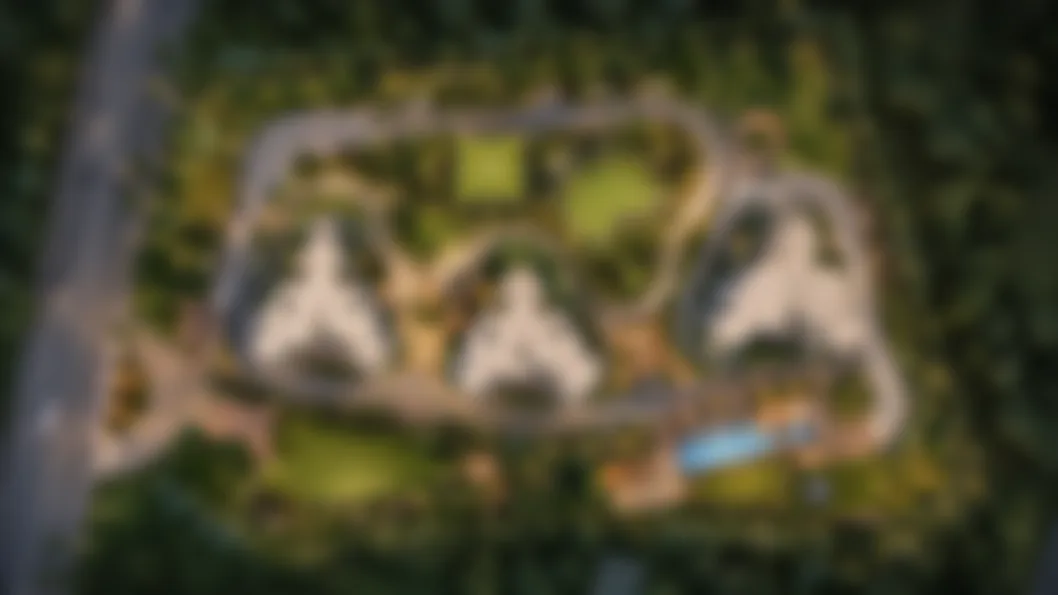
Purva Park Royale is planned on 6 acres as a single gated township with three G+27 towers. This is a deliberate choice. By building up to G+27 on a contained footprint rather than spreading low-rise blocks across the plot, the planning pushes more value into open-space quality - the towers are distributed to maximise the central courtyard and the inter-tower spacing. Purva Sanna Amanikere is useful for the site-planning lens because buyers should read open space, movement, parking, and amenity placement as everyday-use details, not brochure decoration.
The project communication highlights roughly seventy percent open area. In practical planning terms, this translates into a generous central courtyard, more meaningful amenity placement, and improved visual permeability from apartments and circulation spaces. For end users, that can mean a campus where the walk from the tower lobby to the clubhouse or pool is through landscape rather than across parking.
A second important design decision is the vertical stacking and the pedestrian-first courtyard: vehicular circulation is kept to a perimeter loop with basement and podium parking, leaving the central courtyard and amenity zones as pedestrian-first space. This separates car movement from the family-and-play areas and improves both acoustic comfort and the experiential quality of the amenity deck.
Tower Placement, Privacy, and Movement Flow
The three-tower arrangement is meaningful beyond architecture aesthetics. Adequate separation between the G+27 masses preserves daylight, cross-ventilation, and privacy - a non-trivial detail at 27-storey heights, where poor spacing produces canyon effects and overlooking. Primary living rooms and master bedrooms are oriented toward the central landscape rather than directly onto the road frontage, with a planted perimeter buffer dampening Kanakapura Road noise.
From a user perspective, master planning should be tested against three movement loops: arrival loop, daily vertical loop, and lifestyle loop. Arrival loop covers the single controlled gateway, the drop-off, and the transition from entry to private zones. Vertical loop covers lift distribution within each tower. Lifestyle loop covers access quality to the clubhouse, open spaces, and recreation nodes. Purva Park Royale’s plan attempts to optimize all three by keeping vehicular movement on a perimeter loop and preserving open-zone continuity in the courtyard.
Buyers should still validate these assumptions during the final documentation stage by asking for the latest master plan sheet, lift core details, and amenity placement plan. A premium launch is strongest when architecture narrative and engineering reality are aligned.
6-Acre Footprint and the 70% Open-Space Discipline
The Purva Park Royale master plan organises 450 apartments across three G+27 towers on a 6-acre parcel - a mid-scale township that sits between the corridor's boutique 3-acre launches and the 50-acre mega-townships further out. The built footprint is concentrated in the three towers and the central clubhouse, with roughly 70% of the plot reserved as open space, landscape, and amenity zones. By building up to G+27 rather than out, the towers free the bulk of the ground plane for a courtyard that reads as a park rather than a setback. The towers are positioned to maximise the central open space, with a planted perimeter buffer along the Kanakapura Road frontage absorbing road noise before it reaches the residential cores, and living rooms oriented inward toward the landscape.
Central Courtyard, Clubhouse and Amenity Clusters
The central courtyard, between the three towers, hosts the social spine of the campus. The standalone clubhouse anchors one edge, connected directly to the swimming-pool deck, with the kids' zones and the central lawns distributed through the courtyard. The tennis and multi-sport courts sit at the landscape edge, away from the tower bases so residential acoustic comfort is preserved, while the jogging and walking tracks thread between the gardens, the sports zones, and the children's areas. A single controlled gateway off the approach road leads into the perimeter driveway, with a boom barrier, guard cabin, and CCTV cluster routing vehicular movement around the core to the basement and podium ramps. The STP, organic waste converter, DG yard, and transformer are clustered on the plot edge with planted screening, keeping mechanical noise and waste handling away from the residential cores.
Towers, Parking and Below-Ground Infrastructure
Each of the three towers rises to G+27 (~145 m), served by multiple high-speed passenger lifts plus service lifts sized for peak-morning traffic in a ~150-home-per-tower configuration. Below and around grade, the basement and podium levels accommodate covered parking, the on-site sewage treatment plant with treated-water reuse for landscape and flushing, rainwater-harvesting pits and percolation zones from roof and surface runoff, the dedicated electrical substation and BESCOM transformer yard, DG backup for essential and apartment loads, fire-fighting tanks and pumps meeting Karnataka Fire Services requirements, an organic waste converter, and the domestic water tanks with combined borewell and BWSSB sourcing. The utility cluster is screened on the plot edge, and service movement is routed via the perimeter driveway - separated from the residential entry experience by design.
Planning Snapshot
Open Space, Amenity Placement, and Long-Term Value
In premium apartment projects, master plan quality has a direct link to long-term value retention. Specifications can be upgraded over time, but poor core planning is almost impossible to fix post-handover. That is why open-space quality, walkway logic, activity zoning, and building setbacks matter more than one-time launch visuals.
For Purva Park Royale, the planning narrative suggests meaningful open-space intent with the clubhouse, pool, sports courts, and landscaped gardens integrated into the central courtyard rather than pushed into residual corners. A standalone clubhouse, swimming pool and kids' pool, tennis and multi-sport courts, and distributed landscape are core components, but their placement and accessibility ultimately determine real usage. Well-planned amenity placement reduces dead zones and keeps common areas active without creating noise spill into the residential towers.
Another planning implication is micro-market positioning. Projects that offer stronger internal planning often attract both better end-user demand and comparatively stable resale interest because buyer decision-making at this ticket size is increasingly quality-sensitive. In that context, the master plan is not just a drawing sheet-it is the core operating blueprint for everyday life and long-term asset behavior.
For serious buyers, final due diligence should include: latest stamped master plan, amenity zoning confirmation, traffic circulation logic, and evacuation/safety circulation review. These checks make sure the launch promise is structurally supportable before commitment.
A practical checkpoint is to ask for stack-by-stack visibility impact and service movement separation details. Premium projects often describe privacy intent at launch, but the real test is whether planning reduces visual overlap between facing units and whether service operations are kept discreet. If these aspects are documented clearly, buyers can evaluate long-term livability with greater confidence.
When reviewed this way, master planning becomes a measurable quality filter rather than a brochure section.
Planning visuals are indicative references sourced from current records. Verify latest approved and stamped master plan documents before booking.
Need a guided walkthrough of the master plan sheet with amenity zoning, circulation, and stack logic explained in plain language?
Due-diligence references
Read together with gallery and location on this website. Compare landscape distribution, amenity placement, tower or plot spacing, and how clearly each plan supports everyday movement inside the community.
Purva Park Royale Master Plan FAQs
What is the master plan footprint for Purva Park Royale?
The development is planned on a 6-acre site with three G+27 towers (~145 m), approximately 450 apartments, and a central resort-style clubhouse. Roughly 70% of the site is set aside as open space, landscape, and amenities, which underpins the township positioning.
How is density managed in the Purva Park Royale master plan?
At 450 units across 6 acres, the gross density is around 75 units per acre - moderate for a G+27 high-rise township. By building up rather than out, the three towers concentrate the floor area on a small ground footprint, freeing roughly 70% of the plot for landscape, amenities, and circulation.
What community spaces are planned within the Purva Park Royale master plan?
The plan accounts for a central clubhouse with 45-plus amenities, a swimming pool and kids' pool, tennis and multi-sport courts, jogging and walking tracks, kids' and toddler zones, a senior-citizens' court, pet zones, landscaped gardens and lawns, an amphitheatre, and basement and podium covered parking.
What is the tower configuration at Purva Park Royale?
Three towers, each G+27 (roughly 145 m tall), distributed to maximise central open space and inter-tower spacing for light, air, and privacy, with living rooms and master bedrooms oriented toward the central landscape rather than the road. Floor-plate placement is part of the sanctioned plan to be filed under K-RERA.
When will the Purva Park Royale master plan be finalised publicly?
The sanctioned master plan and the K-RERA-registered approved plan are the authoritative references. Both are awaited at the pre-launch stage. Working drawings shared today are directional until those are filed.
Can the Purva Park Royale master plan still change before launch?
Yes - until BBMP/BDA sanction and K-RERA registration are filed, layout details, tower placement, and amenity footprints can be adjusted by the developer. Buyers should ask for the latest stamped plan during sales discussions rather than relying on early renders.