
Four Configurations, Full Demand Curve
Purva Park Royale offers the full mainstream configuration range - four unit types across the three G+27 towers, each designed around a clear buyer profile. The decision to launch a multi-configuration township, rather than the 3-BHK-only product several recent Kanakapura Road launches have favoured, is deliberate: it lets a household size up or down within the same address, serves multi-generational families with the 4 BHK, and gives investors a spread of ticket sizes. The 2 BHK at ~1,400 sq ft is the corridor entry point; the 3 BHK with study at ~1,500–1,650 sq ft is likely the volume seller; the large 3 BHK at ~1,850–1,950 sq ft is the family-sized three-bedroom; and the 4 BHK at ~2,300–2,400 sq ft is the township differentiator. For layout judgement, Purva Sanna Amanikere adds a same-city product-format lens around usable space, privacy, circulation, and how the home will work day to day.
All configurations share the same building DNA - the same fit-and-finish standard, the same clubhouse and 45-plus-amenity access, and the same structural and infrastructure systems. The differences are in usable floor area, bedroom count, and the inclusion of a study in the 3 BHK study and the extra bedroom and larger volumes in the 4 BHK. Indicative pricing runs from ₹1.35 Cr for the 2 BHK to ₹2.70 Cr for the 4 BHK, on a basic rate of roughly ₹9,400–₹9,900 per sq ft before statutory taxes (stamp duty, registration, GST) apply.
The 2 BHK at ~1,400 sq ft is generous for a two-bedroom - well above the compact 2 BHKs that crowd some corridor launches - which supports both end-use comfort and the corridor's deep 2 BHK rental demand. The 3 BHK with study is the corridor's sweet-spot configuration: the study/utility room gives work-from-home households a dedicated workspace, serves as a guest or puja room, or converts to a small fourth bedroom.
The 4 BHK is the project's flagship and one of the few genuine four-bedroom options available at township scale on Kanakapura Road. Multi-generational households who need four true bedrooms under one roof, buyers upgrading from a 3 BHK who want a forever-home, and high-ticket investors targeting the corridor's scarce 4 BHK segment all sit inside the intended buyer profile. Its rarity at township scale is itself a resale advantage.
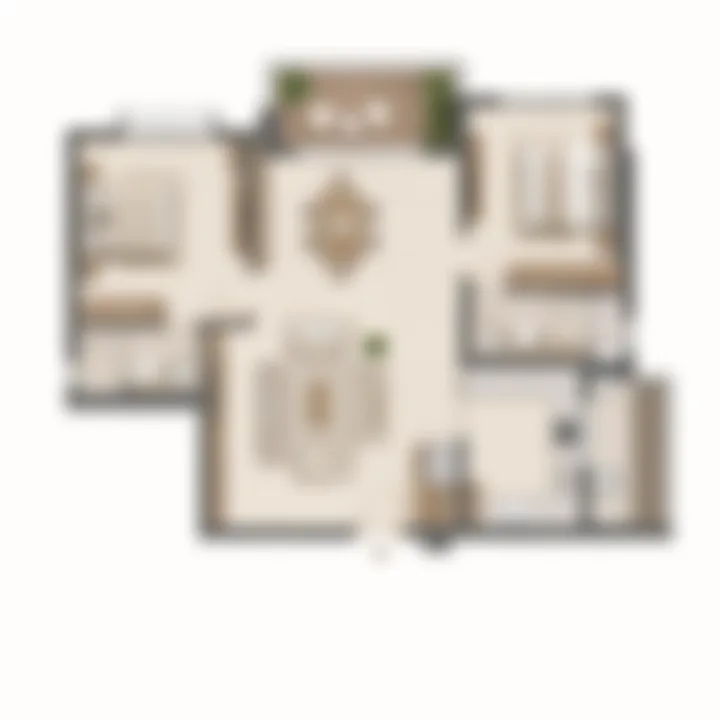
2 BHK
~1,400 sq ft Corridor Entry Point
~1,400 sq ft SBA from ₹1.35 Cr ~₹9,640/sftTwo bedrooms with a master en-suite, a living-dining bay sized for a sofa cluster and four-seater dining, a modular-ready kitchen with utility, and a balcony oriented toward the central landscape. At ~1,400 sq ft it is generous for a two-bedroom - well above the compact 2 BHKs that crowd some corridor launches - suiting couples, small families, and investors targeting the corridor's deep 2 BHK rental pool.
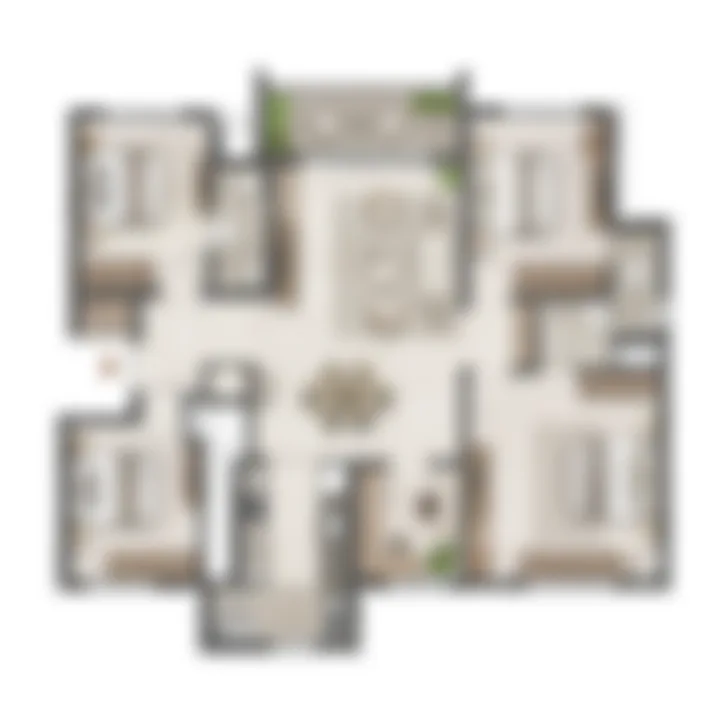
3 BHK (Study)
~1,600 sq ft Volume Configuration With Study
~1,500–1,650 sq ft SBA ₹1.50–1.65 Cr ~₹9,690/sftThree bedrooms plus a study/utility room - a dedicated workspace, guest or puja room, or future fourth bedroom. Master with en-suite, two further bedrooms sharing a common toilet, a multi-zone living-dining bay, and a modular-ready kitchen with utility. The corridor's sweet-spot configuration for growing and work-from-home families. The large 3 BHK (~1,900 sq ft) and the 4 BHK (~2,400 sq ft) extend the same family up the size curve.
Carpet vs Super Built-up - A Buyer Education Note
Under the Real Estate (Regulation and Development) Act, 2016, all sale agreements must reference carpet area - the net usable internal space of the apartment, excluding shared common areas. Super built-up area (sometimes called sellable area) includes a proportional share of common amenities - lift cores, corridors, lobby, clubhouse, and other built infrastructure.
For Purva Park Royale, the published unit sizes (~1,400 to ~2,400 sq ft) are super built-up figures. The carpet area - the net usable internal space, which appears on the formal price sheet and the sale agreement - typically runs 62–66% of the super built-up figure for Bengaluru high-rises, giving indicative carpet areas of roughly 870–925 sq ft (2 BHK), 990–1,055 sq ft (3 BHK study), 1,180–1,255 sq ft (3 BHK large), and 1,490–1,585 sq ft (4 BHK). When comparing Purva Park Royale to other corridor projects, normalise on carpet-area-per-rupee rather than super-built-up-per-rupee for a true like-for-like view. The exact carpet areas will be specified in the K-RERA registration and the sale agreement.
Floor Plate Strategy - Inward Orientation, Central Core
The floor-plate strategy across the three G+27 towers is oriented toward the central landscape. The towers are positioned so primary living rooms and master bedrooms face the courtyard rather than directly onto the road frontage, with a planted perimeter buffer along the Kanakapura Road side. This delivers four practical outcomes: daylight and a green outlook on the primary elevation, cross-ventilation through windows or balconies, acoustic privacy from the road, and a quieter aspect for the units oriented to the courtyard.
Each tower is served by multiple high-speed passenger lifts plus service lifts, sized for peak-morning traffic in a roughly 150-home-per-tower configuration. Within each tower, floor and orientation preference follows the standard Bengaluru high-rise pattern, and the 27-storey height gives buyers a wider elevation range than the corridor's mid-rise launches - from lower floors closest to the clubhouse and courtyard to upper floors with the best long views and the greenest outlook.
Floor Plan Selection - How To Think About It
For pre-launch buyers entering at the EOI stage, three considerations matter when choosing a floor-plate position:
- Aspect and view direction. West- and north-facing units typically command a small premium for evening sunlight and lower afternoon heat load. East-facing units get morning sun and are preferred by some buyer segments.
- Vertical position. Lower floors (3–8) are easier for older buyers and families with young children - faster lift access, easier evacuation, closer connection to the ground plane. Upper floors (15–20) command premium pricing for views and a sense of distance from street noise.
- Corner vs middle plate. Corner units within the 8-unit floor plate get dual aspect - windows on two external sides - and are typically priced at a small premium.
A practical selection method between the two configurations:
- Choose the 2 BHK (~1,400 sq ft) if you are a couple or small family, want the corridor's deepest rental pool, or are building a long-term rental portfolio. The generous footprint sets it apart from the compact-2 BHK norm.
- Choose the 3 BHK study (~1,600 sq ft) if you are a growing or work-from-home family wanting flexibility - the study can be a home office today and a child's room later. Step up to the large 3 BHK (~1,900 sq ft) for three true double bedrooms, or the 4 BHK (~2,400 sq ft) for multi-generational living and a forever-home.
Before finalising, request the latest stamped floor-plan set, carpet area statement, and a full cost sheet aligned to your shortlisted stack and facing. That single step prevents most post-booking confusion around expectations, dimensions, and payment staging. Floor-plate availability, exact corner positions, and aspect angles will be shared by the relationship manager at the EOI stage and finalised at sale agreement.
It is also useful to test your shortlisted plan against real furniture and usage scenarios. Mark dining size, work-from-home desk zones, children's study flexibility, and wardrobe depth assumptions before booking. For the 2 BHK, the larger primary bedroom can comfortably absorb a king-size bed with a small work setup and a reading chair, while the wider living-dining can host 6-person dining without crowding the seating area. For the 3 BHK, the living-dining can comfortably host 8-person dining with a 3-seat sofa configuration, and the two balconies can support indoor plants, evening seating, or a small outdoor dining setup.
Floor plan visuals shown here are reference assets. Final dimensions and area statements should be confirmed from latest developer-issued documents at booking time.
Need a side-by-side comparison of the 2 BHK and 3 BHK with budget impact and family-fit guidance?
Due-diligence references
Compare layouts using master plan and amenities on this website. Look at built-up efficiency, plot utility, access width, orientation, and whether flexibility matters more than ready apartment planning.
Purva Park Royale Floor Plans FAQs
What floor plans does Purva Park Royale offer?
Four configurations across three G+27 towers: 2 BHK (~1,400 sq ft), 3 BHK with study (~1,500–1,650 sq ft), 3 BHK large (~1,850–1,950 sq ft), and 4 BHK (~2,300–2,400 sq ft) super built-up. All configurations share the same fit-and-finish standard and the same clubhouse and amenity access - one of the few corridor launches to offer a genuine 4 BHK at township scale.
What is the size of a 2 BHK at Purva Park Royale?
The 2 BHK is approximately 1,400 sq ft super built-up - generous for a two-bedroom, well above the compact 2 BHKs that crowd some corridor launches. It has two bedrooms with a master en-suite, a living-dining bay sized for a sofa cluster and four-seater dining, a modular-ready kitchen with utility, and a balcony oriented toward the central landscape.
What does the 3 BHK at Purva Park Royale include?
Two 3 BHK variants are offered: the 3 BHK with study (~1,500–1,650 sq ft), which adds a study/utility room for a home office, guest room, or future fourth bedroom; and the large 3 BHK (~1,850–1,950 sq ft) with three full double bedrooms, a master with walk-in wardrobe, a generous living-dining bay, and two or more balconies.
What is the indicative price for each configuration?
Indicative pricing runs from ₹1.35 Cr for the 2 BHK, ₹1.50–1.65 Cr for the 3 BHK study, ₹1.80–1.95 Cr for the large 3 BHK, and ₹2.30–2.70 Cr for the 4 BHK, on a basic rate of roughly ₹9,400–₹9,900 per sq ft. Stamp duty, registration, GST, BWSSB deposits, and fit-out are over and above the base price.
How are the apartments arranged across the towers at Purva Park Royale?
The 450 apartments are distributed across three G+27 towers, positioned to maximise central open space and inter-tower spacing for light, air, and privacy. Living rooms and master bedrooms are oriented toward the central landscape, with the road-facing side buffered by a planted perimeter. Each tower is served by multiple high-speed passenger lifts plus service lifts.
Are the published sizes carpet or super built-up area?
The published figures (~1,400 to ~2,400 sq ft) are super built-up area. At a typical premium high-rise carpet-to-super-built-up ratio of 62–66%, the indicative carpet areas are roughly: 2 BHK ~870–925 sq ft, 3 BHK study ~990–1,055 sq ft, 3 BHK large ~1,180–1,255 sq ft, and 4 BHK ~1,490–1,585 sq ft. The exact carpet areas will be specified in the K-RERA registration and the sale agreement.